Zoho consulting and implementation for UK businesses
When sales, customer service and finance work from different records, small gaps create a large amount of chasing. An account manager cannot see an outstanding issue. A customer receives the wrong update. A report needs a spreadsheet before anyone trusts it.
FI Digital helps organisations planning a Zoho implementation or improving the systems they already use. We bring process analysis, configuration and custom integration into one delivery scope. The purpose is to make a defined part of your operation work reliably, with clear ownership after launch.
Three ways to start
Implement a new environment
For a new rollout, we agree the first business process, the people involved and the records it depends on. That creates a basis for selecting applications, designing permissions and planning migration. The first release should be usable by the business, with acceptance criteria that describe complete tasks rather than a list of configured screens.
Improve an existing implementation
If Zoho is already live, we begin with the work that is causing difficulty. The issue may be a data definition, a conflicting automation, an incomplete integration or a process that users cannot follow. A focused review helps distinguish those causes before your team commits to more development or a wholesale rebuild.
Establish ongoing support
Live systems need administration and controlled change as the business develops. A support engagement can cover agreed applications, incidents and enhancements, with responsibilities and service commitments defined in the contract. It should also preserve documentation and access so your organisation can understand the environment it relies on.
Connect customer relationships with the work behind them
CRM design starts with the way your business sells. A professional-services engagement, a distributor account and a recurring service contract have different information needs. We define account structures, stages, responsibilities and approvals around that operating model, including the handoff once a sale becomes a delivery commitment.
Service design then follows the customer’s request through intake, assignment, escalation and resolution. Where Zoho Desk or another application is part of the scope, we establish the information the next person needs and the action that closes the loop. Reporting should make unresolved work visible to someone who can act on it.
Integration where the process crosses systems
Your existing accounting, operational or specialist applications may continue to own important records. We assess which data should move, which system is authoritative and how failed or delayed updates will be handled. The integration scope includes permissions and reconciliation, rather than treating a successful API connection as the end of the work.
Our Australian automotive work provides a relevant international example. A custom Zoho Catalyst connector was deployed across 232 dealerships in two months, delivering website leads into dealer CRMs in seconds. The OEM gained visibility of website-generated and dealership-generated leads and their statuses. The client and CRM products remain confidential.
AI within a defined service boundary
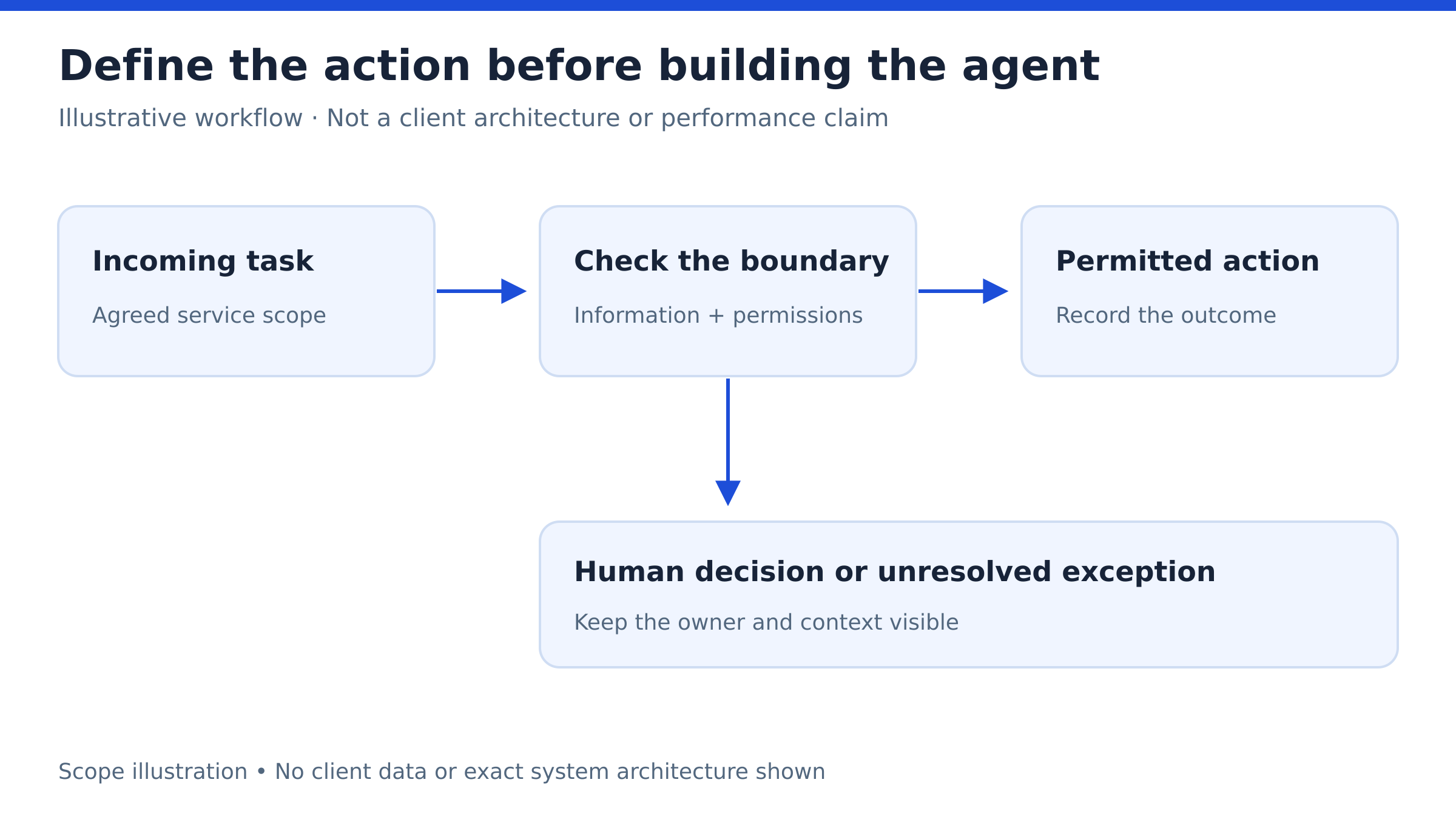
AI can assist a service team when it has suitable information and a clear limit on what it may do. We have delivered an Australian personal injury law-firm implementation using Zoho Desk, the OpenAI API, Zia agents and custom development. The firm reported 70% autonomous resolution across approximately 800 incoming service tickets over six months.
People remained involved for legal-advice enquiries. That boundary is part of the evidence, alongside the percentage and observation period. The example is an Australian engagement, not a claim of UK legal-sector delivery or a promise that another service team will achieve the same result.
Give finance a cost comparison it can use
The complete commitment includes licences, implementation, third-party usage and ongoing operation. Our proposals distinguish these components. The implementation scope should identify configuration, migration, integrations, custom work, testing and training, with assumptions that your team can examine.
AI-assisted development and MCP-based tools can help with parts of delivery. They do not remove the need to reconcile conflicting requirements or agree who owns a process. We assess the actual work and available tools so the estimate reflects the proposed engagement. Your team can then compare alternatives against the same deliverables and acceptance responsibilities.
Agree data handling before access is granted
A UK engagement may involve customer information, employee records or commercially sensitive material. Scoping should identify which information is required, where it is processed and who can access it. Contracting entity, subprocessors, support access and retention arrangements should be clear before detailed data is shared.
Your security and privacy owners should review those arrangements against your organisation’s requirements. We do not assume that a local hosting region establishes compliance for every connected service or that one client’s controls are suitable for another. Those decisions belong to the actual engagement and its documented design.
A first discussion with a useful outcome
Bring a process that is costing your team time or making management information unreliable. Explain the systems involved, the affected teams and the decision you need to make. We can then discuss whether the next step is a focused review, a new implementation or a defined improvement project.
The resulting scope should identify the first deliverable, what your team needs to provide, how it will be accepted and who will operate it. That is the basis for a proposal you can evaluate and a release your users can put to work.
Discuss your Zoho requirement. Start with the operating problem and the systems you want to connect.
Frequently asked questions
Can you help a UK business that is already using Zoho?
Yes. An engagement can focus on an existing environment, starting with the workflows, integrations or reporting that need attention. We establish what is working before recommending changes. The proposed scope should distinguish repairs, process changes and new features so your team can decide what to prioritise and how to test the result.
Should we choose Zoho CRM or Zoho One?
The decision depends on which business processes and users need to be supported. CRM may address a focused sales requirement, while a broader suite can be assessed where service, finance or other applications need to connect. Compare current product entitlements, eligible user counts and the complete operating cost before committing to a licence model.
Do the case studies on this page describe UK clients?
The examples here are international delivery references, with their locations stated. The automotive and customer-service projects described are Australian engagements. They demonstrate relevant integration and automation experience, but they are not presented as UK client deployments. Any local reference shared during an evaluation must have the relevant client’s permission.
Can Zoho be integrated with our accounting or operational software?
We assess the available interfaces and the information each system should own before confirming the scope. The design should identify update direction, permissions, duplicate handling and recovery from failed transfers. A connection is useful when the operating process works end to end, so testing should include the relevant business teams as well as developers.
How do you approach UK data protection requirements?
We discuss the data involved, processing locations, access arrangements and contractual responsibilities during scoping. Your organisation’s privacy and security owners should review the proposed approach against its requirements. Selecting a hosting region or enabling a platform feature does not by itself establish compliance across the application, connected services and support arrangements.
Can AI agents be added to our service operation?
A service workflow can be assessed for AI assistance or automation where information sources and action boundaries are clear. Our Australian law-firm example kept people involved for legal advice. A new project needs its own evaluation cases, permissions and escalation rules, with results measured in the actual service operation rather than assumed from another deployment.
How are delivery fees and ongoing costs estimated?
The proposal should separate software subscriptions, implementation, third-party usage and ongoing support. Implementation effort depends on the data, processes, integrations and acceptance work involved. We use AI-assisted tooling where appropriate, while retaining responsibility for coordination and engineering decisions. Compare proposals against the same scope and operating responsibilities rather than just their initial headline fee.
What happens after go-live?
The engagement should identify who owns administration, incidents and approved changes once the release is live. Ongoing support can be scoped around the applications and operating requirements involved. Coverage and response commitments belong in the agreement, along with documentation and access arrangements that allow your team to understand and maintain the delivered solution.
Discuss your Zoho requirement